Early Evaluation
Early orthodontic evaluation creates opportunity.
Seeing an orthodontist while a child is growing allows us to identify developing problems at a time when growth can still be used to our advantage.
Early evaluation does not mean every child starts treatment. It means we can recognize the problems that benefit from timely intervention - especially transverse discrepancies, crossbites and functional shifts - and recommend treatment when timing matters.
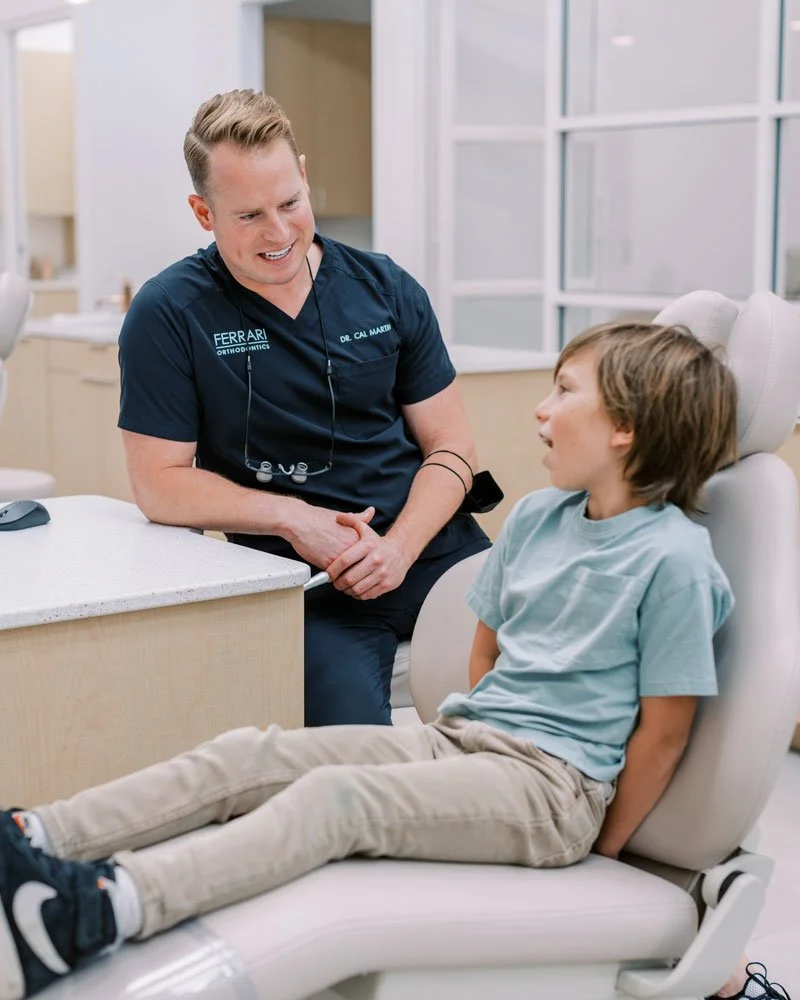
First orthodontic evaluation
Age 7 is a widely recognized time for a first orthodontic evaluation, but it should not become a reason to ignore a concern that is already visible.
If a pediatric dentist identifies a posterior crossbite, narrow upper arch, functional shift, eruption concern or developing bite problem at age 5 or 6, an orthodontic evaluation can be appropriate.
For meaningful transverse problems, earlier evaluation gives us the opportunity to address the discrepancy while the child is growing rather than waiting for a particular birthday.

During the evaluation
An early evaluation considers much more than whether the front teeth look straight.
Dr. Martin considers:
How the upper and lower jaws relate

Whether a crossbite or functional shift is present
How permanent teeth are developing and erupting
Whether space is developing appropriately
Whether the bite is changing in a way that may affect future treatment
When Phase I treatment makes sense
Phase I treatment should address a defined developing problem or create a meaningful developmental advantage.
Examples include crossbites, transverse discrepancies, functional shifts and selected eruption or space problems where treatment during growth offers a clear reason to act now.
For concerns that do not benefit from early intervention, Dr. Martin can monitor development and determine the appropriate future timing. That distinction is made from the diagnosis - not simply the child's age.
See the problem early. Use growth wisely.
Parents do not need to know whether their child needs an expander before they walk through the door.
Bring us the concern. We will evaluate the developing bite, explain what we see and recommend the timing and treatment approach that best uses the child's growth and development.
-
Age 7 is a widely recognized time for a first orthodontic evaluation, but it should not become a reason to ignore a concern that is already visible.
If a pediatric dentist identifies a posterior crossbite, narrow upper arch, functional shift, eruption concern or developing bite problem at age 5 or 6, an orthodontic evaluation can be appropriate.
For meaningful transverse problems, earlier evaluation gives us the opportunity to address the discrepancy while the child is growing rather than waiting for a particular birthday.
-
An early evaluation considers much more than whether the front teeth look straight.
Dr. Martin looks at how the upper and lower jaws relate, whether a crossbite or functional shift is present, how permanent teeth are developing and erupting, whether space is developing appropriately, and whether the bite is changing in a way that may affect future treatment.
-
Phase I treatment should address a defined developing problem or create a meaningful developmental advantage.
Examples include crossbites, transverse discrepancies, functional shifts and selected eruption or space problems where treatment during growth offers a clear reason to act now.
For concerns that do not benefit from early intervention, Dr. Martin can monitor development and determine the appropriate future timing. That distinction is made from the diagnosis - not simply the child's age.
FAQ
Expansion treatments
-
![A stylized illustration outline indicating movement or adjustment to the left and right]()
Palatal Expansion
Making room by addressing width
-
![A stylized illustration outline indicating movement or adjustment to the left and right]()
MARPE
A more skeletal approach to expansion
-
![Magnifying glass icon over an abstract green shape]()
Early Evaluation
Benefiting from timely intervention
-
![Stylized illustration outline of an upper palate with wavy lines.]()
Airway-Conscious
Addressing concerns with breathing
-
![A stylized illustration outline indicating movement or adjustment to the left and right]()
Adult Expansion
Thoughtful expansion strategies for adults